
 分享:
分享:


The co-authored paper by Professor Minggui Yu, Co-Director of the base, Associate Professor Jianfeng An, a researcher at the base, and Mengmeng Zhang of Huazhong University of Science and Technology, titled “Can Strengthening Judicial Protection of Bank Creditor’s Rights Promote Consumer Credit Expansion? Evidence from the Establishment of a Big Data Investigation and Control System,” was published in Finance & Trade Economics, Issue 9, 2026. This journal is an A-Class journal recognized by our university.
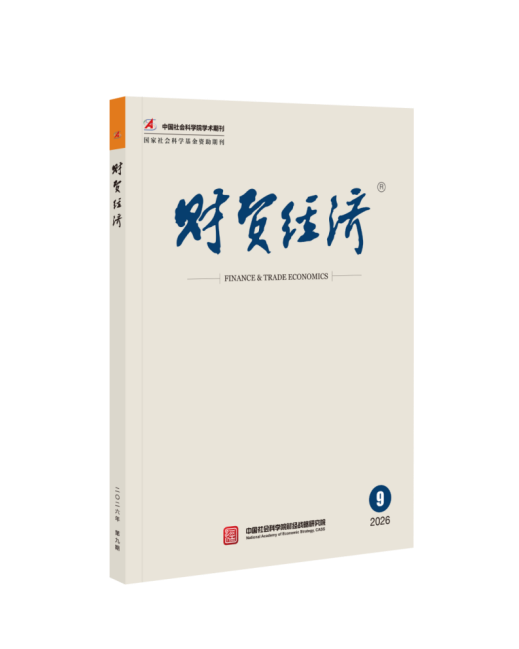
Finance & Trade Economics is an authoritative academic journal in the fields of public finance and trade in China. Founded in 1980, it is supervised by the Chinese Academy of Social Sciences and sponsored by its National Academy of Economic Strategy. The journal focuses on frontier issues such as public finance, finance, trade, and the service economy, emphasizing the integration of theoretical research with policy practice. It is indexed by CSSCI and the Peking University Core Journals, and has received honors including the National Journal Award. It has significant influence in academia and policymaking departments.
Content Summary
Consumption is a key pillar for smoothing the domestic economic cycle and sustaining economic growth, as well as a direct manifestation of meeting people’s aspirations for a better life. General Secretary Xi Jinping has pointed out that it is necessary to establish and improve long-term mechanisms for expanding household consumption, and to accelerate efforts to shore up weaknesses in domestic demand—especially consumption—so that domestic demand becomes the main driving force and stabilizing anchor of economic growth. Against this backdrop, on March 16, 2025, the General Office of the CPC Central Committee and the General Office of the State Council issued the Special Action Plan for Boosting Consumption, which emphasized “encouraging financial institutions to increase personal consumption lending under the premise of controllable risks.” On June 24, 2025, the People’s Bank of China and five other departments released the Guiding Opinions on Financial Support for Boosting and Expanding Consumption, further calling for strengthening the supply of consumer finance. It is therefore clear that enhancing credit support has become an important policy lever for boosting household consumption at present.
However, most bank consumer loans are unsecured credit loans lacking collateral protection, and the difficulty of judicial enforcement after borrower default may dampen banks’ willingness to lend. This raises an urgent question: can improvements in judicial enforcement efficiency effectively unlock financial institutions’ potential to supply consumer credit by strengthening the protection of banks’ creditor rights, thereby promoting the expansion of household consumption?
To strengthen the protection of creditors’ rights, local courts across China have successively established “point-to-point” big-data asset investigation and control systems (hereinafter “point-to-point” systems), which focus on judicial investigation and control within their respective jurisdictions to safeguard the legitimate rights and interests of creditors. These systems are built through the connection of local higher people’s courts with local administrative agencies, financial institutions, and other entities, and integrate large amounts of data on local debtors. When a debtor defaults and harms the legitimate rights and interests of creditors, courts can use the “point-to-point” system to promptly search for and freeze the debtor’s assets for debt repayment. This big-data-based judicial investigation and control overcomes the limitations of the traditional manual model—namely, limited information coverage and the heavy consumption of time and effort—and has become an important piece of infrastructure for judicial enforcement, greatly improving its efficiency.
This paper exploits the establishment of “point-to-point” big-data asset investigation and control systems as a natural experiment. By manually compiling data on consumer lending by local commercial banks, we use a difference-in-differences approach to examine the impact of enhanced protection of banks’ creditor rights on the expansion of consumer credit. The results show that: First, the establishment of big-data investigation and control systems significantly increased banks’ consumer lending, indicating that the development of rule-of-law infrastructure helps channel financial resources into the consumption sector. Second, mechanism analysis shows that the establishment of these systems expanded consumer credit by reducing banks’ lending risk and improving the social credit environment. Third, analysis of economic consequences reveals that the establishment of these systems promoted regional consumption growth, with particularly pronounced effects in areas with high old-age dependency ratios, high child dependency ratios, high housing prices, and high Engel coefficients.
Author Introduction

Professor Minggui Yu is Dean and Doctoral Supervisor of the School of Finance, Zhongnan University of Economics and Law, Chief Expert of a Major Project of the National Social Science Fund of China, and a recipient of the Ministry of Education’s New Century Excellent Talents in University program. His research fields include digital finance, finance and artificial intelligence, corporate finance, and finance and innovation. He has published more than 90 academic papers in many authoritative domestic and international journals, including Economic Research Journal, Management World, The Journal of World Economy, China Economic Quarterly, Journal of Financial Research, China Industrial Economics, Accounting and Finance, Pacific-Basin Finance Journal, and Economic Modelling. He has led more than 10 projects, including Major Projects of the National Social Science Fund of China, Key Projects of the National Social Science Fund of China, and projects funded by the National Natural Science Foundation of China.

Jianfeng An is an Associate Professor at the School of Finance, Zhongnan University of Economics and Law, and a Wenlan Young Scholar. His research has been published in journals such as Management World, Economic Research Journal, Journal of Financial Research, China Industrial Economics, and Finance & Trade Economics. A research report he co-authored received an affirmative instruction from central leadership and was adopted by internal publications of the National Development and Reform Commission. Several of his papers have won honors including the 2024 China Finance Excellent Paper Award, the First Prize of the China Investment Annual Conference, and the Outstanding Paper Award of the Beijing Financial Street Forum.

Mengmeng Zhang is a Lecturer at the School of Economics, Huazhong University of Science and Technology. Her research has been published in journals such as Economic Research Journal, Journal of Financial Research, China Industrial Economics, Finance & Trade Economics, and Studies of International Finance.