
 分享:
分享:


The collaborative paper “Digital Infrastructure Construction, Public Computing Power Supply, and AI Innovation—Evidence from the Construction of Public Intelligent Computing Centers” by Professor Minggui Yu, Co-Director of the Base, Zhuomin Sun, a doctoral student at the School of Finance, Zhongnan University of Economics and Law, and Professor Lin William Cong of Nanyang Technological University, was published in Issue 8, 2026 of Economic Research Journal. This journal is recognized by our university as an A+ authoritative journal.
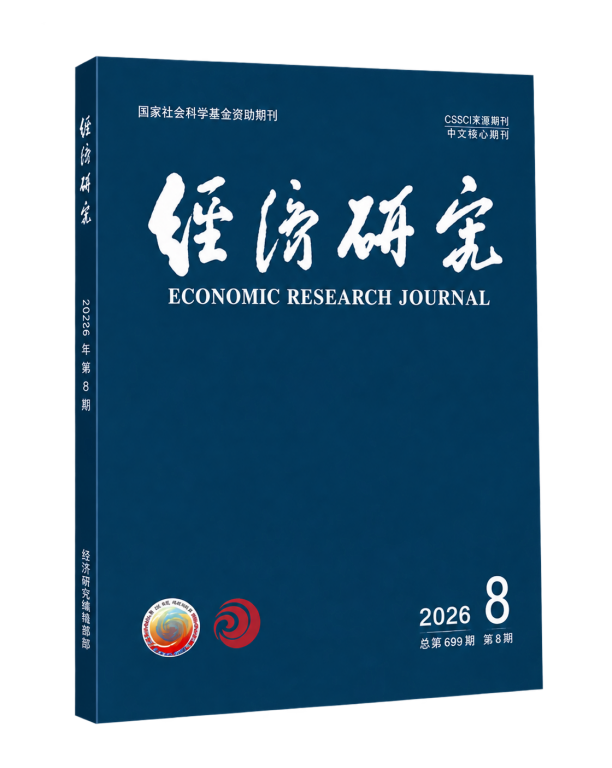
Economic Research Journal is a top-tier academic journal in the field of economics in China. Founded in 1955, it is sponsored by the Institute of Economics, Chinese Academy of Social Sciences. As a comprehensive journal of economic theory, it adheres to Marxism as its guiding ideology, is grounded in China’s realities, and is committed to publishing high-level original articles that study major theoretical and practical issues in the process of reform and opening up, economic development, and transformation. The journal is indexed by CSSCI, the Peking University Core Journals, and other important domestic indexes. Its composite impact factor ranks among the top in the economics category, and it has received multiple honors, including the National Journal Award. It has broad and far-reaching academic influence in China’s economics community and policymaking departments.
Content Summary
Computing power, data, and algorithms are the three core elements driving AI innovation. However, compared with algorithms and data, the economic impact of computing power supply has not yet received sufficient attention. Because intelligent computing power is characterized by large upfront investment, high technical barriers, and significant economies of scale, SMEs find it difficult to bear the fixed investment and operating costs of building their own computing power, and are also easily constrained by the relatively high rental prices of commercial computing power. Since 2019, local governments across China have successively built public artificial intelligence computing centers to improve enterprises’ access to computing power through lower costs and inclusive services. Based on this institutional practice, this paper focuses on examining: Can the government’s provision of public computing power through digital infrastructure lower the threshold for SMEs to participate in AI innovation and stimulate their innovation vitality?
Theoretically, drawing on technology adoption and real options theory as well as factor complementarity theory, this paper analyzes the internal mechanisms through which public computing power supply affects corporate innovation decisions. Public intelligent computing centers can not only improve the availability of computing power but also enhance the stability and predictability of computing power supply, thereby reducing the value of waiting for firms to delay innovation investment. At the same time, computing power is complementary to R&D investment and specialized talent. Improvements in computing power supply conditions can raise the marginal output of other innovation factors, thereby prompting firms to increase R&D and talent investment. To test the above theoretical expectations, this paper takes firms listed on the New Third Board (NEEQ) from 2016 to 2023 as the sample, constructs a firm-level AI patent database based on patent data from the China National Intellectual Property Administration and the Patent Classification System for Key Digital Technologies (2023), and manually compiles information on the construction of public and commercial intelligent computing centers across various regions. Exploiting the quasi-natural experiment formed by the successive completion and operation of public intelligent computing centers, it employs a staggered difference-in-differences (DID) method for identification.
The study finds that the construction of public intelligent computing centers significantly increased firms’ number of AI patent applications, with a more pronounced promoting effect on AI firms. Tests of the computing power channel indicate that this effect is mainly concentrated among firms with stronger ex ante potential demand for computing power. Heterogeneity analysis further reveals that the construction of public intelligent computing centers had a stronger promoting effect on AI innovation among private firms and small-scale firms, suggesting that firms with relatively limited resource acquisition capacity benefit more from public computing power supply. After the completion of public intelligent computing centers, firms also increased R&D investment and the allocation of AI-skilled talent. Furthermore, the construction of public intelligent computing centers not only increased the quantity of AI innovation but also improved the quality of AI innovation, promoted the diffusion of AI knowledge into other technological fields, and enhanced firms’ total factor productivity. This paper extends the study of infrastructure innovation effects to computing power infrastructure, reveals the complementary relationship between computing power and R&D investment and human capital, and, from the perspective of the public provision of key production factors, reveals a new path for government support of enterprise innovation.
Author Introduction

Professor Minggui Yu is Dean and Doctoral Supervisor of the School of Finance, Zhongnan University of Economics and Law, Chief Expert of a Major Project of the National Social Science Fund of China, and a recipient of the Ministry of Education’s New Century Excellent Talents in University program. His research fields include digital finance, finance and artificial intelligence, corporate finance, and finance and innovation. He has published more than 90 academic papers in many authoritative domestic and international journals, including Economic Research Journal, Management World, The Journal of World Economy, China Economic Quarterly, Journal of Financial Research, China Industrial Economics, Accounting and Finance, Pacific-Basin Finance Journal, and Economic Modelling. He has led more than 10 projects, including Major Projects of the National Social Science Fund of China, Key Projects of the National Social Science Fund of China, and projects funded by the National Natural Science Foundation of China.

Zhuomin Sun is a doctoral student at the School of Finance, Zhongnan University of Economics and Law. Research interests include the digital economy and artificial intelligence, finance and innovation/entrepreneurship, and corporate finance. Research findings have been published in Economic Research Journal.

Lin William Cong is a President’s Chair Professor at Nanyang Technological University, Associate Dean and Professor at Nanyang Business School, and concurrently Professor at the College of Computing and Data Science. He is the Founding Director of the Global Institute for Finance, Technology and Society (GIFTS). His main research areas include fintech, the digital economy, artificial intelligence and big data finance, blockchain and crypto assets, financial data science, the digital platform economy, and innovation and entrepreneurship financing, among others.