
 分享:
分享:


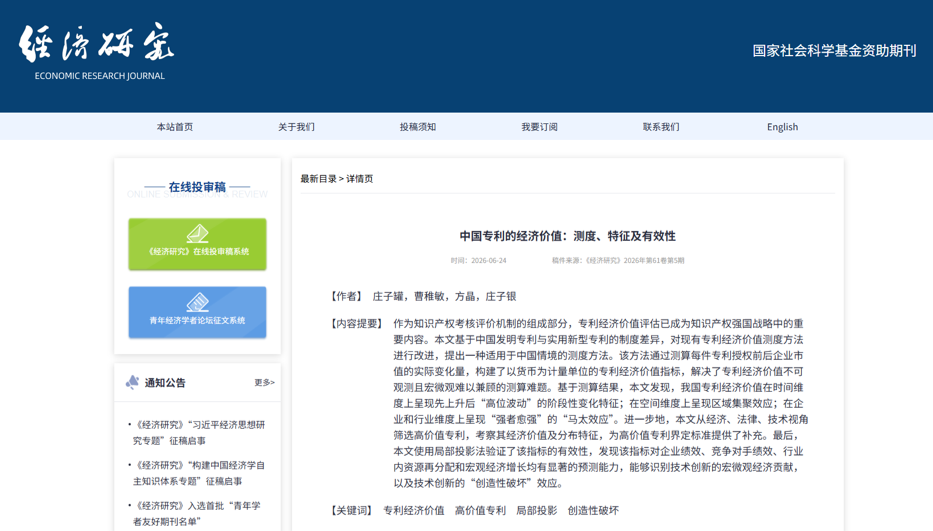
Base researcher Professor Ziguan Zhuang co-authored the paper "The Economic Value of Chinese Patents: Measurement, Characteristics and Effectiveness" with Dr. Zhimin Cao from the School of Finance, Associate Professor Jing Fang from Wenlan College at Zhongnan University of Economics and Law, and Professor Ziyin Zhuang from the School of Economics and Management at Wuhan University. The paper was published in Economic Research Journal, Issue 5, 2026. The journal is classified as an A+ journal by Zhongnan University of Economics and Law.
选题背景和意义
Since the implementation of the Patent Law of the People's Republic of China in 1985, China's patent applications have continued to grow, ranking first in the world for many consecutive years. The number of granted patents has also surged from 3,024 in 1986 to nearly 3.7 million in 2024. However, this rapid growth has raised concerns among many scholars regarding the quality of China's patents. To promote the shift of intellectual property (IP) work from quantity pursuit to quality improvement, the Outline for Building a Strong Intellectual Property Country (2021–2035) explicitly requires "reforming and improving the intellectual property assessment and evaluation mechanism with quality and value as the criteria," thereby better protecting and encouraging high-value patents. The 15th Five-Year Plan outline further requires that the number of high-value invention patents per 10,000 population exceed 22 by 2030. China has also regarded the protection and utilization of intellectual property as an important lever for innovation-driven economic development. Under the guidance of these goals, the primary link in the commercial utilization of patents—patent economic value assessment, that is, the scientific measurement of their expected economic returns—is particularly crucial. Therefore, constructing an effective measurement system for the economic value of Chinese patents has become an important research topic with both academic value and practical policy significance. This not only concerns the smooth implementation of the strategy for building a strong intellectual property country, but also provides foundational support for implementing the innovation-driven development strategy and achieving high-level self-reliance and strength in science and technology. However, China's patent system has its own unique development path and structural characteristics. Existing foreign measurement methods struggle to fit the Chinese local context and constantly face the applicability dilemma of "acclimatization failure." Against this backdrop, it is urgently necessary to develop a patent economic value measurement method that suits China's institutional characteristics and real market environment.
主要内容和结论
Based on the reality of China’s patent system, this paper improves existing measurement methods and proposes an approach for measuring patent economic value suited to the Chinese context; the basic idea is to use patent grant data and stock trading data to calculate the actual change in firm market value around each patent grant, thereby constructing a micro-level indicator of patent economic value. This measurement method offers the following advantages: first, it applies to different patents with varying characteristics, giving it a broad scope of application; second, it uses currency as the unit of measurement, accommodating both macro- and micro-level economic value measurement; third, it improves upon existing methods and remedies their deficiencies by accounting for the institutional differences between invention patents and utility model patents, thereby enabling a more accurate assessment of the economic value of Chinese patents. The core improvement lies in relaxing two key assumptions: allowing the market to have heterogeneous reactions to patent grant events of different types, and allowing the market’s ex-ante expected probability of patent grants to change dynamically. Compared with indicators obtained using existing methods, the patent economic value indicator constructed in this paper shows a stronger positive correlation with patent quality indicators, thereby confirming the rationality and necessity of our improved approach. Based on the measurement results, this paper systematically examines and tests the multi-dimensional distribution characteristics of patent economic value in China from 1997 to 2016: patent economic value exhibits a phased pattern of first rising and then “high-level fluctuation” in the temporal dimension, shows regional agglomeration effects in the spatial dimension, and displays a “Matthew effect” of “the strong getting stronger” in the firm and industry dimensions. Furthermore, this paper screens high-value patents from economic, legal, and technical perspectives, tests their economic value and distribution characteristics, and provides supplementary evidence for the definition criteria of high-value patents. In addition, this paper uses the local projection method to verify the effectiveness of the patent economic value measurement indicator, finding that it has significant predictive power for firm performance, competitor performance, intra-industry resource reallocation, and macroeconomic growth; it can identify the macro and micro economic contributions of technological innovation, as well as the “creative destruction” effect of technological innovation (especially substantive innovation represented by invention patents). The marginal contributions of this paper are as follows: first, it constructs a macro and micro measurement system for the economic value of Chinese patents, and our measurement method addresses the shortcomings of existing approaches and is suitable for the local context, enabling more accurate assessment of the economic value of Chinese patents; second, it reveals the distribution characteristics of patent economic value and provides supplementary evidence for current high-value patent definition criteria from the perspective of economic value; third, it verifies the “creative destruction” effect of technological innovation and its macro and micro economic contributions, revealing the key role of invention patents in intra-industry resource reallocation and the reshaping of competitive landscapes; fourth, the patent economic value indicator can predict future economic fundamentals, indicating that financial markets can anticipate potential returns before patent commercialization and guide capital flows to R&D firms. Therefore, this paper not only provides a forward-looking expectation indicator, but also offers new evidence for financial markets supporting the development of the real economy.
政策启示和建议
First, patent value assessment is a critical foundation for cultivating and commercializing high-value patents, as empirical results show that high-value patents excelling from economic, legal, and technical perspectives all possess substantial intrinsic value; therefore, local governments should establish a scientific and comprehensive patent value assessment indicator system, comprehensively identify high-value patents based on multi-dimensional indicators such as economic, legal, and technical metrics, and accordingly implement differentiated patent funding and support policies, with specific measures including leveraging multi-dimensional assessment results to provide targeted support in the operation funding and pledge financing of high-value patents, thereby incentivizing the cultivation and creation of high-value patents and promoting the commercialization and utilization of existing patent stocks. Second, the unbalanced distribution characteristics of patent economic value in China should be highly valued, and targeted measures should be adopted to promote structural optimization: governments should use tools such as tax incentives to encourage large enterprises to drive small and micro enterprises in their supply chains to jointly enhance patent value, and improve the intellectual property financial support system (such as technology insurance premium subsidies) to alleviate financing constraints for small and micro enterprises; for disadvantaged regions and industries, differentiated funding schemes should be formulated based on regional industrial foundations and industry-specific technological characteristics, linking subsidies to the cultivation and commercialization of high-value patents within each sector, while cities with leading innovation levels should serve as growth poles to radiate and drive surrounding cities to form a spatial pattern of collaborative enhancement of patent value, and jointly promote the creation and utilization of high-value patents through co-construction and interconnection of commercialization platforms. Third, enterprises should be guided to enhance their sense of crisis and raise their awareness of the importance of cultivating and commercializing high-value patents, as research shows that a "creative destruction" effect exists among Chinese enterprises, and the "destructive" effect of substantive innovation represented by invention patents is particularly significant, which highlights the important role of high-value patents in market competition; accordingly, governments should encourage enterprises to fully utilize high-value patents, leverage their defensive and offensive functions in market competition, and promote the construction of a healthy competitive landscape driven by high-value patents, while improving risk-sharing and compensation mechanisms and exploring ex-ante risk compensation models to incentivize enterprises to cultivate high-value patents given the high R&D costs and potential risks. Fourth, the dual role of patent economic value in macro forecasting and capital allocation should be fully leveraged to optimize the functional linkage between financial markets and the intellectual property system: on the one hand, the predictive role of patent economic value should be utilized by incorporating it into the leading indicator monitoring system for the real economy to assist macroeconomic regulation; on the other hand, the signaling function of patent economic value should be leveraged by integrating it into the credit approval, investment decision-making, and risk pricing systems of financial institutions to guide the efficient allocation of social capital, and for patents with high economic value that have not yet been commercialized, financial support should be provided through intellectual property pledge financing and other means, thereby accelerating the realization of their value and facilitating the transformation of expected returns into actual returns.
作者简介

Ziguan Zhuang is a Professor and Doctoral Supervisor at the School of Finance, Zhongnan University of Economics and Law, and Director of the Carbon Trading and Carbon Finance Research Center at Zhongnan University of Economics and Law. He holds a Ph.D. in Finance from Wuhan University and completed postdoctoral research at Peking University. He has led projects funded by the National Social Science Fund of China, the National Natural Science Foundation of China, and the Humanities and Social Sciences Fund of the Ministry of Education, and has participated in major projects of the National Social Science Fund as well as major projects of the Ministry of Education for research in philosophy and social sciences. He has accumulated extensive experience in academic research, policy consultation, and project-based research in the fields of macrofinance, monetary policy, carbon markets, and carbon finance.

Zhimin Cao is a Ph.D. candidate at the School of Finance, Zhongnan University of Economics and Law. Research interests include macrofinance, innovation and macroeconomics, and corporate finance, with research findings published in Economic Research Journal.

Jing Fang is an Associate Professor at Wenlan College, Zhongnan University of Economics and Law. She earned a Ph.D. from the University of Minnesota. Her research interests include industrial organization theory, applied microeconomics, and the digital economy. She has published multiple articles in journals such as the Journal of Development Economics, Journal of International Money and Finance, and Bulletin of Economic Research, and serves as an anonymous reviewer for journals including the Journal of Development Economics and China Economic Review.

Ziyin Zhuang is a Second-Level Professor and Doctoral Supervisor at the School of Economics and Management, Wuhan University. He has long focused his research on technological innovation, the innovation-driven development strategy, and theories and policies of the digital economy and digital innovation. He has authored more than 10 books, including Innovation, Imitation, Intellectual Property and Global Economic Growth. He has led more than 30 research projects, including two major projects of the National Social Science Fund of China, key projects of the National Social Science Fund, and projects of the National Natural Science Foundation of China. He has published nearly 100 papers in leading domestic and international journals such as Social Sciences in China, Economic Research Journal, Management World, and China Economic Review.