
 分享:
分享:


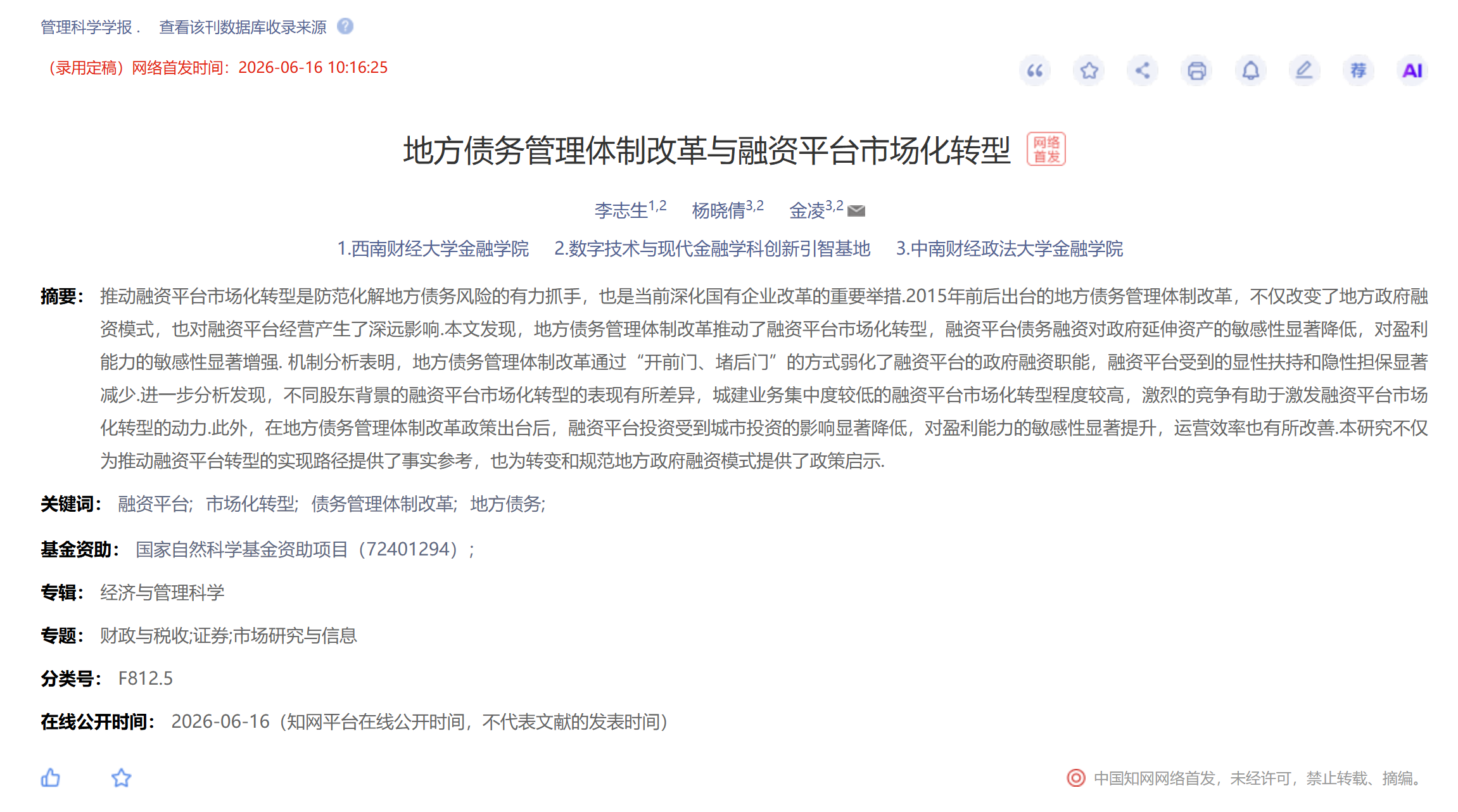
Professor Zhisheng Li, Director of the base (first author), Associate Professor Ling Jin, a researcher at the base (corresponding author), and Dr. Xiaoqian Yang from the School of Finance, Zhongnan University of Economics and Law, have published a collaborative paper titled “Local Debt Management System Reform and Market‑Oriented Transformation of Financing Platforms” in the Journal of Management Sciences in China (online first on CNKI). This journal is recognized as an A+ category journal by Zhongnan University of Economics and Law.
论文简介
Financing platform companies are an important component of local state‑owned enterprises (SOEs). Their distinctiveness lies primarily in the fact that financing platforms not only serve as the main vehicle for local government debt, but also undertake functions such as infrastructure construction and industrial investment promotion on behalf of local governments. These characteristics have led most financing platforms to adopt a high‑debt‑density investment and operation model, resulting in excessive expansion of their debt scale and, to a considerable extent, dragging down their operational efficiency. Therefore, promoting the market‑oriented transformation of financing platforms is not only a primary pathway for preventing and resolving local debt risks, but also of great significance for strengthening, enlarging, and enhancing SOEs.
The main bottleneck to this transformation lies in the fact that, given the important role financing platforms play in local urban development and construction, local governments tend to provide strong support through asset injections, risk co‑guarantees, and other means, enabling financing platforms to secure large‑scale debt financing and achieve rapid expansion. At the same time, driven by the goal of maintaining and increasing the value of state‑owned assets, financing platforms have a strong incentive to expand their scale. Under this model, financing platforms can achieve scale expansion without facing fierce market competition, which has created a severe path dependency. In view of this, the key to promoting the market‑oriented transformation of financing platforms lies in stimulating their motivation for market‑based operations while advancing local debt governance.
Around 2015, China began to implement reforms to the local debt management system, following the approach of “opening the front door and closing the back door” with a series of major policy measures. While granting local governments the right to issue government bonds, these reforms explicitly prohibited local governments from borrowing through channels other than government bonds. This fundamentally changed the financing model of local governments, helped to strip financing platforms of their government financing functions, and had a profound impact on their operations.
The study finds that the local debt management system reform has promoted the market‑oriented transformation of financing platforms. The sensitivity of financing platform debt financing to government‑extended assets has significantly decreased, while its sensitivity to profitability has significantly increased. Mechanism analysis indicates that the reform weakens the government financing functions of financing platforms through the “open front door, close back door” approach, with both explicit support and implicit guarantees significantly reduced. Further analysis reveals that the performance of market‑oriented transformation varies among financing platforms with different shareholder backgrounds. Financing platforms with lower urban development business concentration exhibit a higher degree of market‑oriented transformation, and intense competition helps to stimulate their motivation for such transformation.
In addition, following the implementation of the reform policies, the impact of urban investment on financing platform investment has significantly diminished, while sensitivity to profitability has notably increased, and operational efficiency has also improved. The contributions of this study are mainly reflected in three aspects. First, by leveraging the policy shock of local debt management system reform, it provides an in‑depth analysis of financing platform behavioral decision‑making from the perspective of market‑oriented transformation, offering important supplementary insights into the non‑market path dependency of local SOEs and the governance logic of forced market‑oriented transformation. Second, by incorporating the investment, financing, and market‑oriented transformation behaviors of financing platforms into the analytical framework of local debt governance, it helps to clarify the effects and mechanisms through which local debt governance influences real‑economy enterprises. Third, by focusing on the institutional environment underlying the non‑market operations of financing platforms, it analyzes the pathways of their market‑oriented transformation and examines the heterogeneous effects of institutional reforms on promoting such transformation from the perspectives of shareholder background, functional characteristics, and competitive environment, providing new insights into the motivational differences and necessary conditions for SOE reform.
作者简介

Zhisheng Li is a Member of the Standing Committee of the Party Committee and Vice President of Southwestern University of Finance and Economics, where he also serves as a Professor and Doctoral Supervisor at the School of Finance. He is the Director of the Base for Discipline Innovation and Talent Introduction in Digital Technology and Modern Finance. His primary research areas include financial innovation, financial risk management, market microstructure, and regional financial development. He has led a number of research projects, including those funded by the Higher Education Discipline Innovation and Talent Introduction Program (the “111 Program”), the Major Program of the National Social Science Fund of China, and the Young Scientists Fund and General Program of the National Natural Science Foundation of China. His research has been published in journals such as Economic Research Journal, Journal of Management Sciences in China, China Economic Quarterly, China Industrial Economics, Journal of Financial Research, Journal of Banking and Finance, and Journal of Financial Markets.

Ling Jin is an Associate Professor at the School of Finance, Zhongnan University of Economics and Law, holds a Ph.D. in Economics, and is a Young Scholar of the “Wenlan Scholar” program. His research interests include financial development, financial innovation, and financial markets. He has published multiple papers in renowned domestic and international journals such as Economic Research Journal, Journal of Management Sciences in China, China Economic Quarterly, China Industrial Economics, Journal of Financial Research, and Journal of Financial Markets. He has presided over a Young Scientists Fund project of the National Natural Science Foundation of China and participated in a number of research projects, including a Major Program of the National Social Science Fund of China. He has received awards including the Special Prize for Outstanding Research Achievements of CTTI Think Tanks, the Annual Best Paper Award of the Finance Alliance, and the Annual Best Paper Award of Journal of Financial Research.

Xiaoqian Yang is a Ph.D. candidate at the School of Finance, Zhongnan University of Economics and Law. Her research interests include local debt governance and bank management. Her research has been published in the Journal of Management Sciences in China.