
 分享:
分享:


Recently, Weiyi Zhao, a young researcher at the base, together with Professors Lin William Cong, G. Andrew Karolyi, and Ke Tang, published a high-quality academic research paper titled “Crypto Value, Factor Pricing, and Market Segmentation” in the top international journal Management Science. This is another landmark achievement of the School of Finance’s talent recruitment strategy that emphasizes “potential and development.”
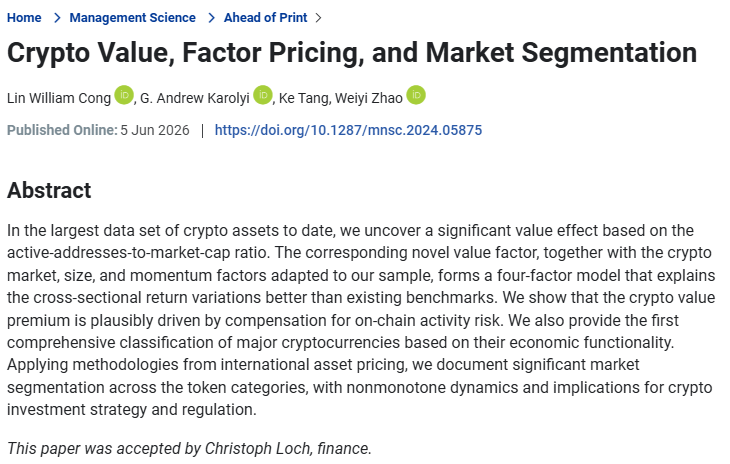

This paper identifies a significant“value effect”in the crypto asset market, based on the on‑chain metric of Active‑Addresses‑to‑Market‑Cap ratio. A novel value factor constructed from this metric, combined with a crypto market factor, a size factor, and a momentum factor, yields a four‑factor pricing model for crypto assets (C‑4). At the same time, this paper provides the first systematic classification of major crypto assets by economic function, offering a comprehensive analytical framework for understanding asset pricing and market segmentation in this emerging financial market, and adding important Chinese wisdom to crypto‑asset research.
Beyond publishing in a top‑tier academic journal, Lecturer Weiyi Zhao was awarded the National Natural Science Foundation of China’s Young Scientists Fund (Category C) in his first year of employment. This project, oriented towards the frontier of the digital economy, focuses on the pricing mechanisms and risk regulation of next‑generation financial infrastructures—a highly forward‑looking and critical topic in the field of fintech.
The dual achievements of Lecturer Zhao—both in top‑tier publication and in securing a research grant—exemplify the School of Finance’s distinctive system for attracting and cultivating talent, and its vigorous efforts to stimulate the innovative vitality of young scholars. In recent years, the School has consistently adhered to a “strengthening the institution through talent” strategy, adopting forward‑looking and potential‑oriented criteria when recruiting, and building a ladder of growth for young faculty like Weiyi Zhao who possess immense academic promise. Looking ahead, the School will continue to provide a broad research platform for all types of talent, with sincerity in valuing talent, courage in deploying it, and magnanimity in accommodating it, so as to help more young scholars achieve outstanding growth while serving major national strategic needs.
Author profile
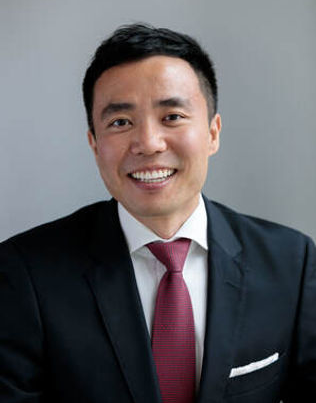
Lin William Cong is the Nanyang President’s Chair Professor at Nanyang Technological University, serving as Associate Dean and Professor at Nanyang Business School, as well as Professor at the College of Computing and Data Science. He is the Founding Dean of the Global Institute for Finance, Technology and Society (GIFTS). His primary research areas include fintech, the digital economy, artificial intelligence and big data in finance, blockchain and crypto assets, financial data science, digital platform economics, and entrepreneurial finance.

Andrew Karolyi is the Charles Field Knight Dean of the SC Johnson College of Business at Cornell University, and the Harold Bierman Jr. Distinguished Professor of Management. He is a Fellow of the Academy of International Business. His primary research areas include international financial markets, investment finance, asset management, corporate finance, emerging markets, sustainable finance, and global business.
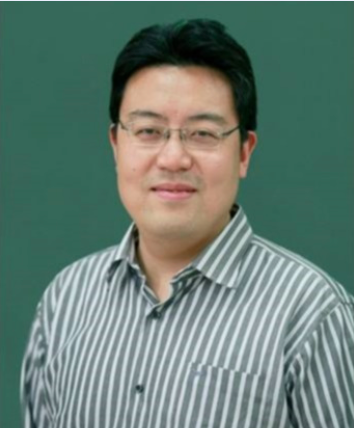
Ke Tang is a Professor and Doctoral Supervisor at the Institute of Economics, School of Social Sciences, Tsinghua University, and serves as the Dean of Zhishan College. He is a member of the National Data Expert Advisory Committee. His primary research areas include data factors, digital assets, commodity markets, fintech, and the digital economy.

Weiyi Zhao is a Lecturer at the School of Finance, Zhongnan University of Economics and Law. His primary research areas include digital assets, fintech, and the digital economy.