
 分享:
分享:


(Corresponding student: Yiran Ji) On June 24, 2026, the special lecture “Frontier Forum on Digital Technology and Economic Finance, Issue 58: Applications of AI Agents in Social Science Research” was successfully held in Conference Room 506, South Wing of Wenquan Building. The lecture was delivered by Assistant Professor Wenli Xu from the Faculty of Finance, City University of Macau. It was hosted by Professor Yongbin Lyu, Deputy Director of the Innovation and Talent Base for Digital Technology and Finance. More than sixty faculty members and students attended the event on site.
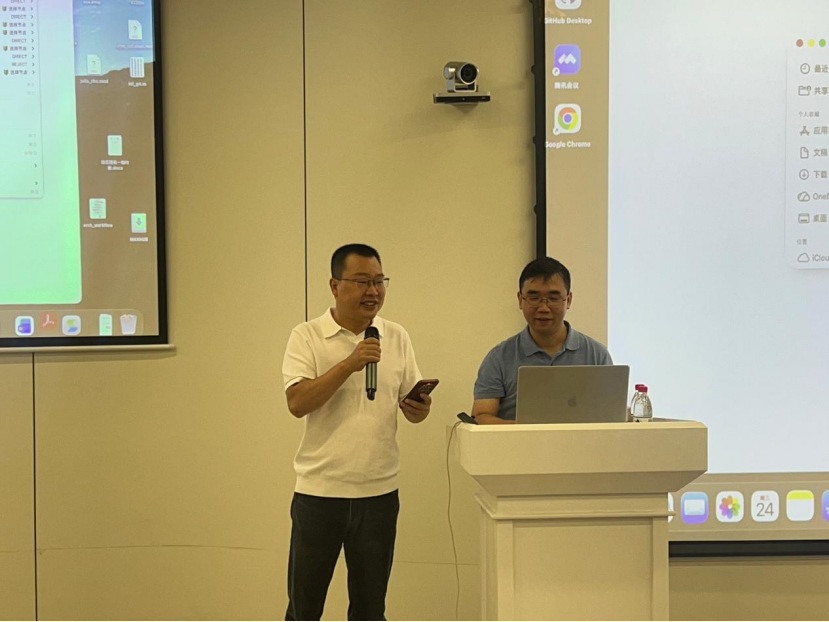
After a brief opening remark by Professor Yongbin Lyu, the lecture officially commenced. The core of the talk focused on the fundamental differences between AI agents and traditional conversational AI. Professor Wenli Xu pointed out that daily-used dialogue tools such as Doubao and Kimi can only handle basic Q&A interactions, whereas the new generation of AI agents possess autonomous task‑planning capabilities and the ability to fully automate end‑to‑end processes on computers. They can autonomously read local data, run code, correct errors, and organize charts and graphs, covering the entire workflow of economic research.
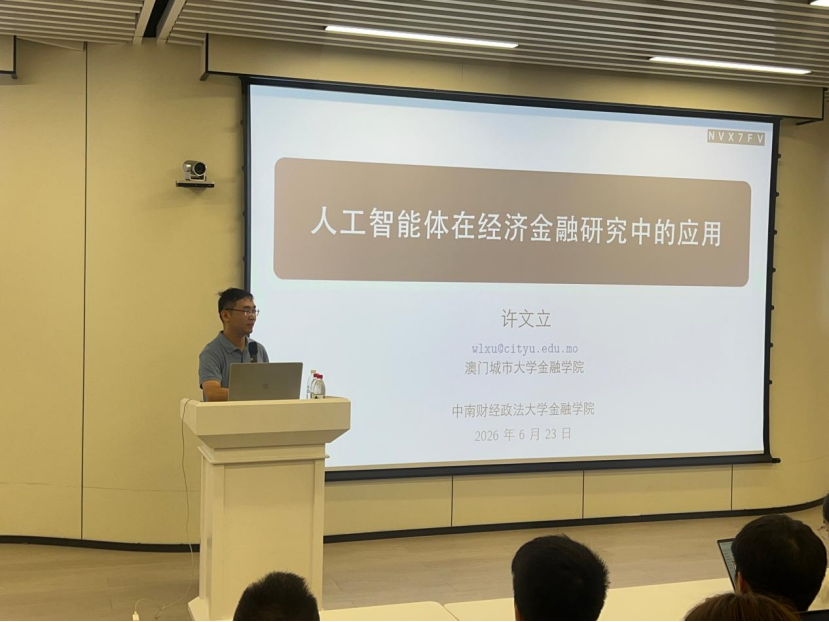
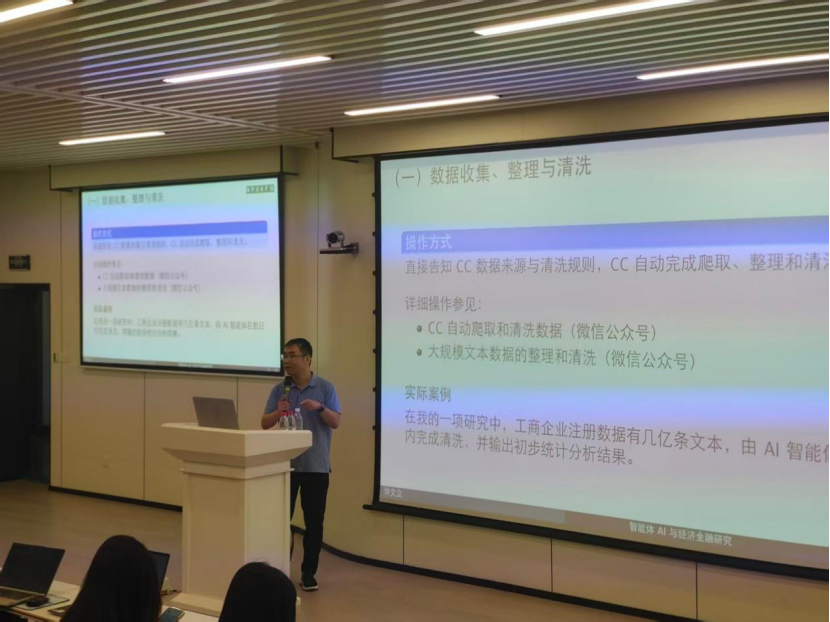
Professor Xu then drew on practical econometric scenarios to share four key applied use cases. First, automation of econometric methods: AI agents can read cutting‑edge papers and automatically generate code for DID and DSGE models. Second, agents can autonomously log into databases such as PKU Law to batch‑download policy documents and annual reports of listed companies, automatically identify duplicate files, correct inconsistent data formats, and efficiently process hundreds of millions of raw observations. Third, after setting up targeted search parameters, the AI can push daily updates on relevant findings from the top five economics journals, automatically generate standardized literature tables that summarize research variables, methodologies, and core conclusions. Fourth, with one click, it can produce supporting case studies, standardized PowerPoint slides, and demonstration code, significantly reducing instructors’ preparation workload.
In addition, Professor Xu highlighted the potential risks and academic integrity requirements associated with the application of AI agents. First, when processing massive datasets, AI agents are prone to overlooking outliers and duplicate data; researchers must therefore keep operation logs and chat histories, and preserve the entire data‑processing workflow for future verification. Second, while AI can handle all mechanical empirical steps, it lacks the ability to interpret economic logic, which may lead students to produce papers with appealing numerical results but weak theoretical foundations. Third, he firmly opposed the practice of generating a complete paper with one click and submitting it directly. When using AI, students should proactively inform their supervisors about the scope of application to ensure transparency and reproducibility of the research. Professor Xu emphasized that AI should only serve as a research assistant; core research ideas, theoretical logic, and the interpretation of economic mechanisms still require independent thinking by researchers. For students of social sciences, causal logic and real‑world economic insights remain core competencies that AI cannot replace.
During the interactive Q&A session, faculty and students raised questions on the proper use of AI in graduation theses, performance differences between domestic and international large language models, and methods for verifying empirical results. Professor Xu addressed each question thoroughly and proposed a standardized workflow: first, develop a complete empirical research plan in advance; then, assign each step to the AI for execution, verifying the results at each stage before proceeding to the next. He also suggested using mobile phones to remotely approve AI‑run tasks and keeping comprehensive logs throughout the process to ensure academic traceability. He encouraged students to actively engage in hands‑on practice and accumulate research experience at the intersection of AI and economics through real‑world application.
Finally, Professor Yongbin Lyu expressed his gratitude to Professor Wenli Xu for his insightful sharing. This lecture clearly deconstructed the underlying logic of how AI agents are reshaping economic research—not only demonstrating the efficiency gains brought by digital tools, but also clarifying the bottom line and core values of academic inquiry. The faculty and students present all agreed that the lecture was both cutting‑edge and practical, helping to define the boundaries of AI tool usage and offering clear, feasible guidance for future empirical paper writing and academic research.
Speaker Introduction
Wenli Xu holds a Ph.D. in Economics and is an Assistant Professor at the Faculty of Finance, City University of Macau. His research focuses on China’s macroeconomic policies, environmental and climate policies, DSGE modeling, computational economics, difference‑in‑differences (DID) methods, and AI applications in economics. He has published over 70 articles in leading Chinese and international journals including Economic Research Journal, China Economic Quarterly, World Economy, Journal of Economic Behavior and Organization, Journal of Environmental Economics and Management, Journal of Regulatory Economics, Journal of Competitiveness, Journal of Innovation & Knowledge, and Public Finance Review. He is the author of the monograph Promoting Green Development and has served as principal investigator for four key research projects funded by the Ministry of Education’s Humanities and Social Sciences Fund, the Ministry of Finance, and the Department of Education of Anhui Province. His research has received numerous awards, including the Deng Ziji Outstanding Tax Paper Award, the Second Prize of Anhui Provincial Outstanding Social Science Achievements, the Special Prize of Shaanxi Provincial Outstanding Humanities and Social Science Achievements in Higher Education, the First Prize of Shaanxi Provincial Outstanding Social Science Achievements, and the Tenth Ministry of Education Outstanding Research Achievement Award (Humanities and Social Sciences). Several of his policy consultation reports have also received approving instructions from national leaders and ministerial authorities.
Frontier Forum for Digital Technology and Finance introduction
Recent years have witnessed a dramatic acceleration in a digital revolution in economic sectors and a rapid adoption of the new generation of information technologies, such as artificial intelligence, blockchain, cloud computing, big data, etc. These technologies effectively set off the digital economy. It has become a key driving force in creating global economic growth, improving the modernization level of governance capabilities, and promoting high-quality economic development in China. In particular, digital finance is the most important part of the digital economy. To explore the development direction of the cross-integration of digital technology and finance, the Innovation and Talent Base for Digital Technology and Finance is hosting the “Frontier Forum for Digital Technology and Finance”, in collaboration with the School of Finance, Wenlan School of Business, Economics School, School of Information and Safety Engineering, School of Statistics and Mathematics, School of Public Finance and Taxation of Zhongnan University of Economics and Law (ZUEL). This lecture series will invite the well-known scholars at home and abroad in digital technology, digital economy, digital finance, and other related fields as guest speakers, providing an open and cutting-edge academic exchange platform for interdisciplinary research on digital technology and finance.