
 分享:
分享:


(Corresponding student: Jinyang Li) On June 18, 2026, the "Frontier Forum on Digital Technology and Economic Finance, Session 57: AI as Co-Developer: Ramsey Taxation, Public Debt, and Self-Insurance" special lecture was successfully held in Conference Room 508, South Wing, Wenquan Building. The session featured Professor Zhigang Feng from the Department of Economics at the University of Nebraska at Omaha as the keynote speaker, who delivered an in-depth presentation on the cutting-edge theme "AI as Co-Developer: Ramsey Taxation, Public Debt, and Self-Insurance." The lecture was moderated by Professor Yongbin Lu, Deputy Director of the Innovation and Talent Base for Digital Technology and Finance, with over thirty faculty members and students attending in person.
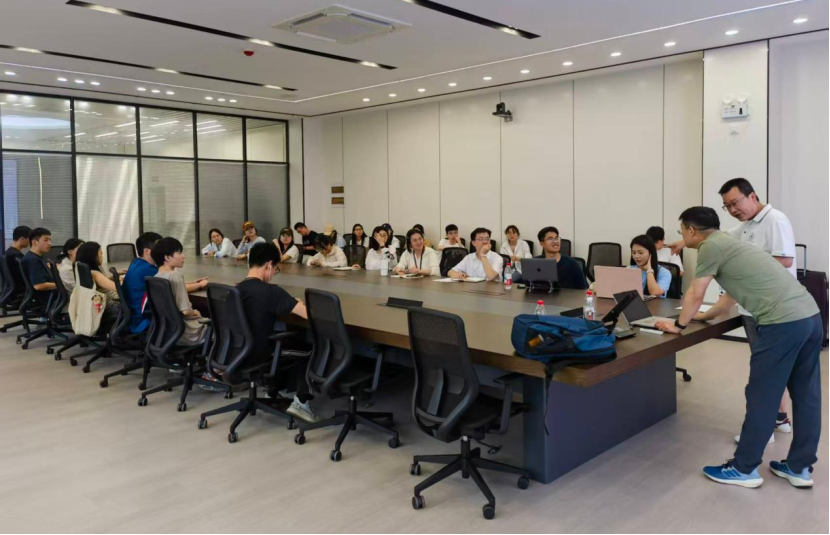
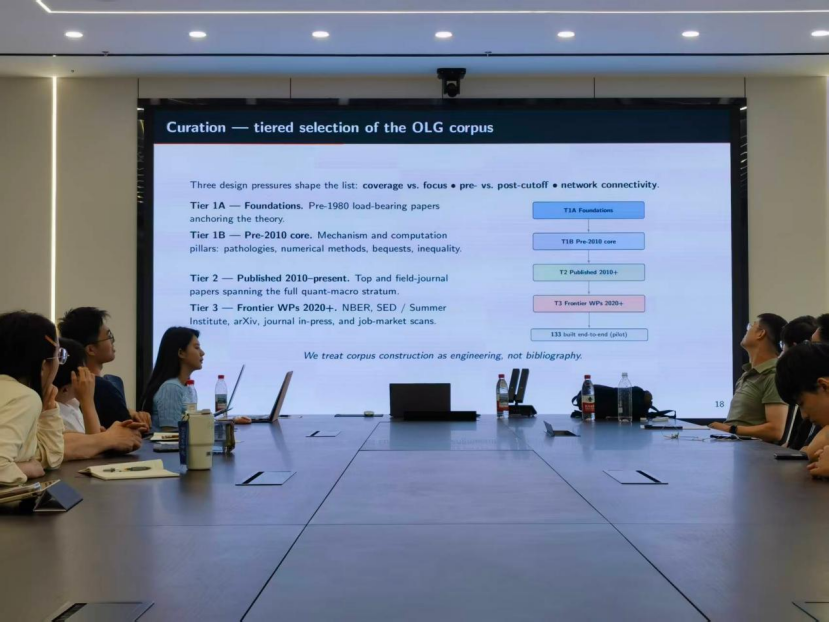
The lecture officially began after a brief opening remark by Professor Yongbin Lu. Professor Zhigang Feng first pointed out that although large language models can reason about economics fluently, their generative reasoning is constrained by the memorized content during training and the way queries guide attention. To address this, he and his collaborators proposed a novel approach that incorporates structured retrieval into economics literature: within a curated corpus, each paper is extracted according to the "PromptEcon" framework, which comprises 9 categories and 51 elements connected by typed edges, and the instantiated papers are then consolidated into a unified knowledge graph through standardized concepts. On this basis, a HippoRAG‑style retrieval mechanism is employed to augment the context before model generation—re‑ranking the model's parametric memory to point to relevant regions and supplementing it with new research published after the training cutoff. Professor Feng applied this method as a pilot study to the Overlapping Generations (OLG) literature and evaluated it through blind peer review and algorithmic code generation tests. He emphasized that this approach is not unique to the OLG field, but is a replicable general framework—turning any structured economics literature into a retrievable foundation for AI‑assisted research.
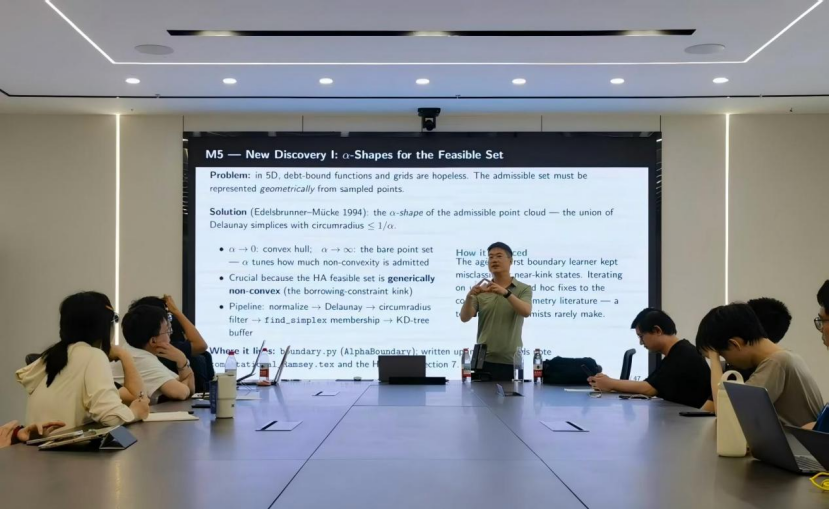
Subsequently, Professor Zhigang Feng, drawing on two research projects he participated in—particularly the second one—vividly demonstrated the practical application of AI as a "co‑developer" in economic research. He pointed out that his core work in this research revolved around Ramsey taxation and public debt. Under the framework of heterogeneous agents and incomplete markets, the government faces stochastic fiscal expenditure shocks and needs to finance its spending through distortionary taxes and non‑contingent debt. At the same time, consumers can self‑insure through savings. Professor Feng shared in detail his research workflow in collaboration with AI: first, he started from a simple representative‑agent model, manually simplifying the model and algorithm to the most basic version to ensure that AI could understand the core logic; then, after AI correctly reproduced the simplified version, he gradually increased the complexity, eventually extending the model to the heterogeneous‑agent case. Professor Feng particularly emphasized that the key to this process lies in the quality of the "starting point"—researchers must have a deep understanding of the model, be able to provide AI with clear and accurate initial settings, and continuously test and correct AI's outputs throughout the process.
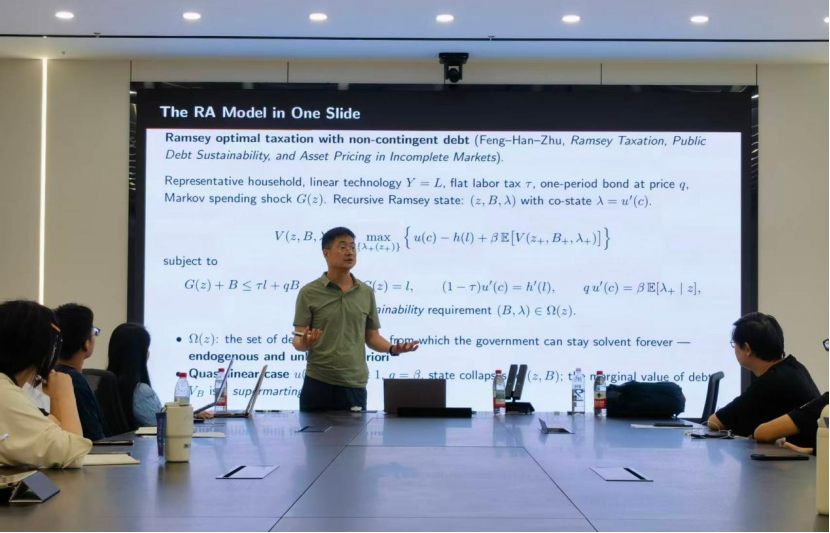
In the demonstration session, Professor Zhigang Feng showed how he handed over the entire model, algorithm, and code to AI, enabling it to autonomously extend the framework after grasping the basic logic. He found that AI not only successfully generalised the algorithm from the representative‑agent case to the heterogeneous‑agent case, but also identified optimisable aspects in the original method and uncovered new economic implications along the way. Professor Feng summarised this as a “growth‑oriented” strategy: researchers need to design a progressive path for AI, moving from simple to complex, so that AI can understand the essence of the problem at each stage, rather than throwing a highly complicated full model at it from the very beginning. He joked that this process is like teaching—you have to let students first understand the simplest example, rather than handing them a dense paper directly.
Professor Feng also shared specific challenges encountered during the research and how they were resolved. For instance, when solving the model, the algorithm kept deviating and failed to converge to the correct equilibrium. After describing the problem to AI, the system retrieved relevant literature and pointed to a 2010 article published in the Review of Economic Dynamics, whose proposed method precisely addressed the issue. Professor Feng noted that this is exactly the value of AI as a “co‑developer”—it not only executes instructions, but also provides heuristic literature guidance and methodological suggestions when researchers hit bottlenecks.
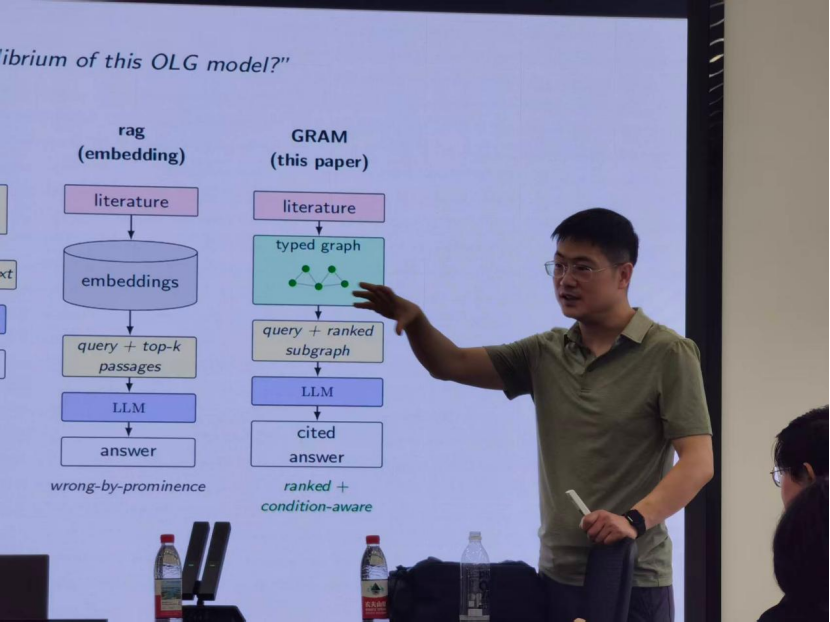
In the latter part of the lecture, Professor Zhigang Feng further introduced the systematic work he is advancing—building economics literature into a retrievable knowledge base. He elaborated on three key steps: first, selecting core literature in a given field (including both classic papers and important recent studies); second, extracting each article into a 51‑dimensional structured representation following the PromptEcon framework; and finally, projecting these representations into a high‑dimensional space so that researchers' questions can be precisely matched with the most relevant literature. Professor Feng emphasised that the goal of this work is not to replace researchers' judgment, but to provide a solid evidentiary basis for AI retrieval and reasoning, thereby avoiding the common hallucination problems of large language models.
During the subsequent Q&A session, Professor Feng engaged in in‑depth discussions with faculty and students on frontier issues such as the feasibility of AI‑assisted research, technical details of knowledge‑base construction, and the adaptability of the approach to different fields of literature. Professor Feng specifically responded to concerns about "how researchers can remain irreplaceable." He pointed out that as AI becomes capable of efficiently handling a large volume of technical work, the core value of researchers will be increasingly concentrated on posing important questions, steering research directions, and making critical judgments. He candidly acknowledged that this realisation has prompted him to re‑adjust his own research scope and focus.
In the latter part of the lecture, Professor Zhigang Feng further introduced the systematic work he is advancing—building economics literature into a retrievable knowledge base. He elaborated on three key steps: first, selecting core literature in a given field (including both classic papers and important recent studies); second, extracting each article into a 51‑dimensional structured representation following the PromptEcon framework; and finally, projecting these representations into a high‑dimensional space so that researchers' questions can be precisely matched with the most relevant literature. Professor Feng emphasised that the goal of this work is not to replace researchers' judgment, but to provide a solid evidentiary basis for AI retrieval and reasoning, thereby avoiding the common hallucination problems of large language models.
During the subsequent Q&A session, Professor Feng engaged in in‑depth discussions with faculty and students on frontier issues such as the feasibility of AI‑assisted research, technical details of knowledge‑base construction, and the adaptability of the approach to different fields of literature. Professor Feng specifically responded to concerns about "how researchers can remain irreplaceable." He pointed out that as AI becomes capable of efficiently handling a large volume of technical work, the core value of researchers will be increasingly concentrated on posing important questions, steering research directions, and making critical judgments. He candidly acknowledged that this realisation has prompted him to re‑adjust his own research scope and focus.
Speaker Introduction
Zhigang Feng is a professor in the Department of Economics at the University of Nebraska at Omaha, and also a chair professor at the School of Economics, Zhejiang University. He serves as a member of the Executive Committee and Director of the Mentorship Program of the Chinese Economists Society, and is the founder of the interview column "Jingbang Lunce". His research interests primarily include macroeconomics, artificial intelligence and machine learning, and computational economics. Part of his research has been funded multiple times by the Swiss National Science Foundation, the Swiss National Supercomputing Centre, and the U.S. National Science Foundation, and has been published in international journals such as International Economic Review, Quantitative Economics, Review of Economic Dynamics, and Economic Theory. He founded the Bilibili channel "Zhongnan Macroeconomics," where he teaches advanced macroeconomics and quantitative macroeconomics. His textbook, Machine Learning and Quantitative Macroeconomics: A Practical Guide with PyTorch, was published by Peking University Press in 2025.
Frontier Forum for Digital Technology and Finance introduction
Recent years have witnessed a dramatic acceleration in a digital revolution in economic sectors and a rapid adoption of the new generation of information technologies, such as artificial intelligence, blockchain, cloud computing, big data, etc. These technologies effectively set off the digital economy. It has become a key driving force in creating global economic growth, improving the modernization level of governance capabilities, and promoting high-quality economic development in China. In particular, digital finance is the most important part of the digital economy. To explore the development direction of the cross-integration of digital technology and finance, the Innovation and Talent Base for Digital Technology and Finance is hosting the “Frontier Forum for Digital Technology and Finance”, in collaboration with the School of Finance, Wenlan School of Business, Economics School, School of Information and Safety Engineering, School of Statistics and Mathematics, School of Public Finance and Taxation of Zhongnan University of Economics and Law (ZUEL). This lecture series will invite the well-known scholars at home and abroad in digital technology, digital economy, digital finance, and other related fields as guest speakers, providing an open and cutting-edge academic exchange platform for interdisciplinary research on digital technology and finance.