
 分享:
分享:


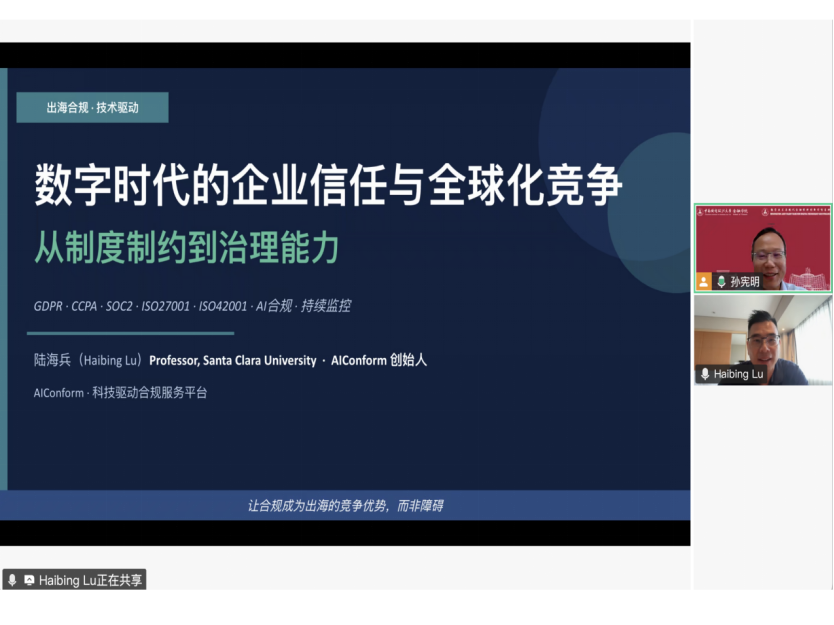
(Corresponding student: Shengke Wu) On June 17, 2026, the special lecture “Frontier Forum on Digital Technology and Economic Finance, Session 56: Corporate Trust and Global Competition in the Digital Age: From Institutional Constraints to Governance Capabilities” was successfully held online. The speaker of this lecture was Professor Haibing Lu, currently affiliated with Santa Clara University in the United States. The moderator was Professor Xianming Sun, Associate Dean of the School of Finance and Executive Deputy Director of the Innovation and Talent Base for Digital Technology and Finance.
The lecture officially began after an enthusiastic opening address by Professor Xianming Sun. First, Professor Haibing Lu, grounded in the macro context of the global digital economy era, identified the core challenge: the competition faced by enterprises is no longer merely about products, technology, or capital, but also about trust and governance capabilities. He pointed out that for firms aspiring to enter global supply chains, governance capability is becoming a core competitive strength on par with technological capability. To move beyond “ivory‑tower” abstract theories, Professor Lu emphasized that this sharing session would focus on practical, down‑to‑earth operational issues, exploring how companies can avoid risks and address the challenges of going global.
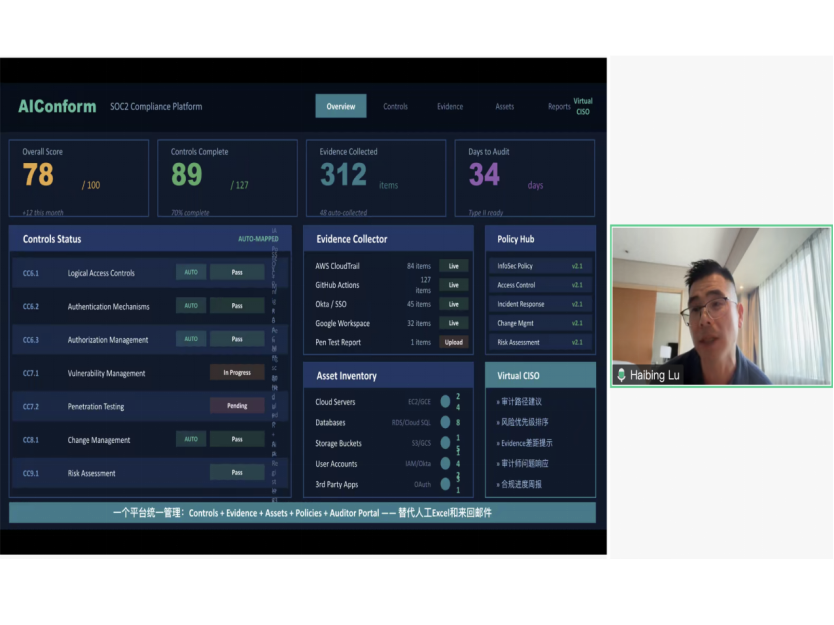
Professor Lu then delved into compliance risks and regulatory challenges in AI deployment, using concrete cases. Taking New York City’s AI hiring law as an example, he illustrated the friction that arises when policymakers attempt to regulate novel technologies with traditional auditing frameworks, highlighting the difficulty firms face in proving compliance. He stressed that compliance has become a make‑or‑break issue for cross‑border enterprises, and elaborated on stringent requirements such as SOC2 internal control standards and GDPR in Western markets. Professor Lu introduced the novel concept of "tech compliance," advocating that companies should adopt full recording of inputs and outputs for post‑hoc traceability, and leverage technical measures to enforce position segregation and code control, thereby transforming external institutional constraints into internal organisational capabilities.
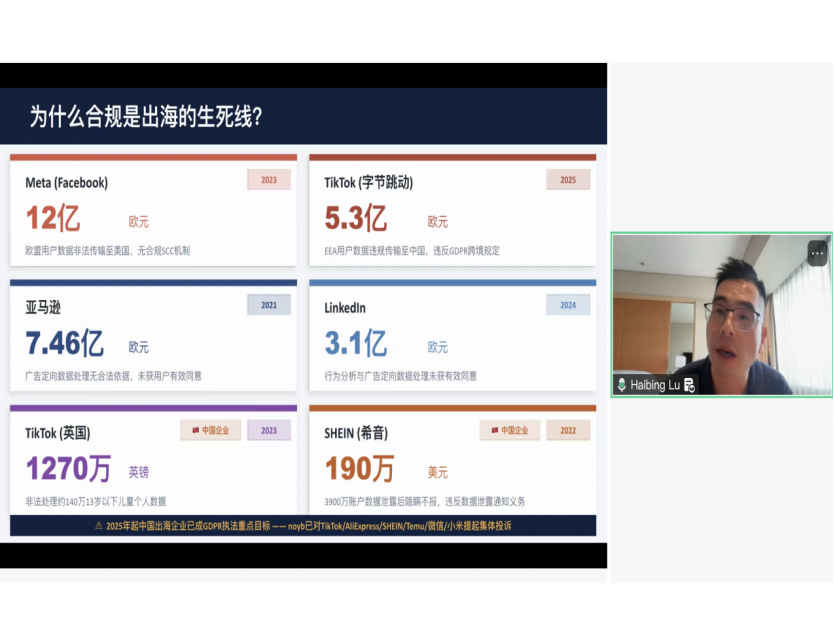
Turning to current trends in open‑source large language models and cybersecurity, Professor Lu argued that addressing complex compliance challenges requires moving beyond a solitary approach and actively engaging cross‑disciplinary expertise. He stressed that turning risk management into a competitive advantage not only reduces the risk of heavy fines but also serves as a gateway to high‑value international contracts and global market expansion. He called on enterprises to embrace innovation by adopting technologies such as federated learning and "trustworthy AI" to strike a dynamic balance between data usability and compliance, while safeguarding privacy and security.
In the Q&A session, participants engaged in lively discussion on data element circulation and compliance practices. Professor Sun raised questions about domestic data asset monetisation and cross‑company data sharing mechanisms. Professor Lu responded clearly that the key to data monetisation lies in full legal compliance and thorough anonymisation of personally identifiable information (PII). Another online participant inquired about China’s cross‑border data transfer policies and their implications for foreign investment. Professor Lu offered detailed answers based on recent cases, recommending that companies benchmark against the highest standards such as CCPA to minimise potential business risks. Finally, Professor Sun thanked Professor Lu for his insightful presentation and extended an invitation for an in‑person visit, bringing the lecture to a successful close.
Speaker Introduction
Haibing Lu is Professor and Chair of the Department of Information Systems and Analytics at Santa Clara University, USA. His research focuses on AI governance and data governance, with publications in top‑tier international journals and conferences in information systems and artificial intelligence. He has received the Best Paper Award from Manufacturing & Service Operations Management (a leading international journal) and the Best Innovation Award from AACSB International, and serves on the editorial boards of several international academic journals. His work has been cited and reported by The New York Times, United Nations reports, Forbes, and others. Beyond academia, Professor Lu is a co‑founder of AIConform, a venture‑backed AI company that leverages artificial intelligence to enhance corporate governance and risk management, empowering firms in their global expansion.
Frontier Forum for Digital Technology and Finance introduction
Recent years have witnessed a dramatic acceleration in a digital revolution in economic sectors and a rapid adoption of the new generation of information technologies, such as artificial intelligence, blockchain, cloud computing, big data, etc. These technologies effectively set off the digital economy. It has become a key driving force in creating global economic growth, improving the modernization level of governance capabilities, and promoting high-quality economic development in China. In particular, digital finance is the most important part of the digital economy. To explore the development direction of the cross-integration of digital technology and finance, the Innovation and Talent Base for Digital Technology and Finance is hosting the “Frontier Forum for Digital Technology and Finance”, in collaboration with the School of Finance, Wenlan School of Business, Economics School, School of Information and Safety Engineering, School of Statistics and Mathematics, School of Public Finance and Taxation of Zhongnan University of Economics and Law (ZUEL). This lecture series will invite the well-known scholars at home and abroad in digital technology, digital economy, digital finance, and other related fields as guest speakers, providing an open and cutting-edge academic exchange platform for interdisciplinary research on digital technology and finance.